

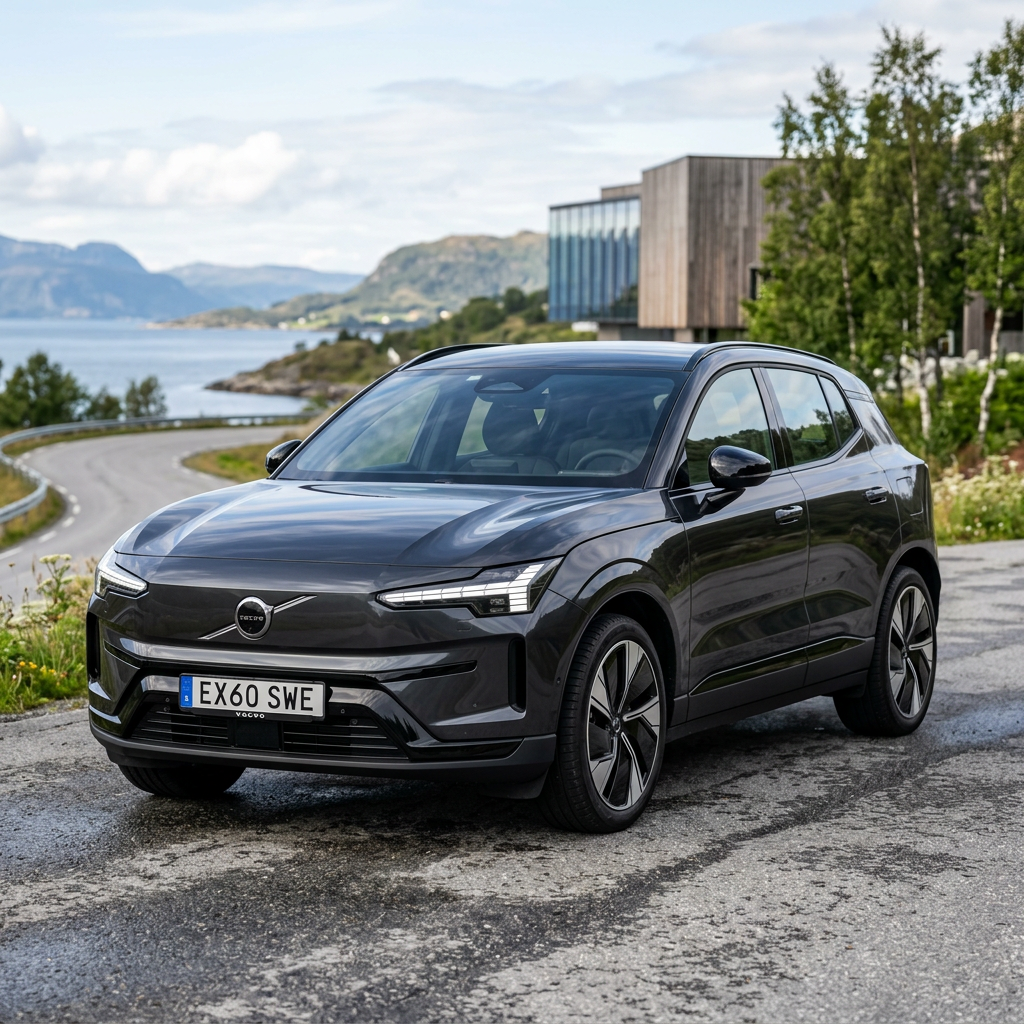


The global electric SUV market is becoming more competitive than ever. Every major automaker is racing toward a future dominated by software-defined vehicles, longer battery ranges, ultra-fast charging, and intelligent driving systems. In the middle of this EV revolution, Volvo has introduced one of its most ambitious products yet — the all-new Volvo EX60.
Positioned as the fully electric successor to the hugely successful XC60, the EX60 is more than just another premium SUV. It represents a complete technological reset for Volvo. Built on a brand-new EV platform and loaded with next-generation battery and AI technology, the EX60 aims to compete directly with future rivals from BMW, Mercedes-Benz, Tesla, Audi, and Polestar.
Volvo describes the EX60 as the vehicle that “changes the game,” and on paper, the SUV certainly has the credentials to back up that claim. With up to 810 km of claimed range, ultra-fast 800V charging, Google Gemini AI integration, advanced safety systems, and a minimalist Scandinavian design philosophy, the EX60 is shaping up to become one of the most important electric SUVs of the decade. (Volvo Cars)
A New Era for Volvo
The EX60 arrives during a crucial period for Volvo Cars. The Swedish automaker has already launched electric models like the EX30 and EX90, but the EX60 could become its most important EV yet because it enters the world’s largest premium SUV segment. (Volvo Cars)
The XC60 has historically been one of Volvo’s best-selling models globally. Rather than simply electrifying the XC60 platform, Volvo decided to create an entirely new architecture specifically designed for electric vehicles. That decision led to the development of the SPA3 platform.
The EX60 becomes the very first vehicle built on this next-generation SPA3 architecture. The platform introduces several advanced engineering concepts, including:
- Cell-to-body battery integration
- Mega casting manufacturing
- 800V electrical architecture
- In-house electric motors
- Advanced software infrastructure
These technologies are designed to improve efficiency, reduce weight, increase range, lower production costs, and deliver a more seamless digital driving experience. (Wikipedia)
Scandinavian Design Meets Aerodynamic Efficiency
Volvo has always been known for minimalist Scandinavian styling, and the EX60 continues that tradition while becoming noticeably more futuristic.
The SUV features:
- Volvo’s signature Thor’s Hammer LED headlights
- Flush door handles
- Clean body surfaces
- Frameless doors
- A sloping aerodynamic roofline
- Full-width rear LED lighting
The design language is elegant rather than aggressive. Unlike many EV competitors that focus heavily on flashy styling, Volvo keeps the EX60 sophisticated and understated.
Aerodynamics played a major role during development. The EX60 reportedly achieves a drag coefficient of around 0.26, helping improve both efficiency and high-speed stability.
The SUV also maintains practical family-friendly proportions with:
- Spacious rear seating
- Large cargo area
- Flat floor layout
- Front trunk (frunk)
This balance between luxury, technology, and practicality is one of the EX60’s biggest strengths.
Interior: Minimalism Powered by AI


Inside the EX60, Volvo pushes its minimalist philosophy even further.
The dashboard is dominated by large digital displays with almost no physical buttons. The cabin uses sustainable materials, clean lines, ambient lighting, and open spaces to create a calm premium environment.
But the real story is the software.
The EX60 introduces Volvo’s next-generation HuginCore software ecosystem powered by:
- Nvidia computing hardware
- Qualcomm Snapdragon processors
- Google Gemini AI integration
The system promises:
- Faster response times
- Smarter voice controls
- Personalized recommendations
- Advanced navigation intelligence
- Improved infotainment performance
Volvo claims the system eliminates lag entirely and creates a more natural interaction between driver and vehicle. (Wikipedia)
Google Gemini integration could become one of the SUV’s standout features. Drivers may be able to interact conversationally with the vehicle for:
- Route planning
- Charging station searches
- Climate control
- Vehicle settings
- Real-time information
This makes the EX60 feel closer to a software platform on wheels than a traditional SUV.
Performance and Powertrain Options
The EX60 will launch with three different powertrain configurations.
P6 Rear-Wheel Drive
The entry-level model produces around 374 horsepower and offers approximately 620 km of WLTP range.
P10 All-Wheel Drive
This dual-motor setup delivers about 510 horsepower and around 660 km of range.
P12 Performance AWD
The flagship version produces nearly 680 horsepower with up to 810 km of claimed range.
Performance figures are highly impressive for a family SUV:
- 0–100 km/h in under 4 seconds for top variants
- Instant electric torque
- Advanced AWD systems
- Low center of gravity
Despite these numbers, Volvo still electronically limits top speed to 180 km/h, continuing its long-standing safety-focused philosophy. (Wikipedia)
Charging Technology That Changes Expectations
One of the EX60’s biggest selling points is its charging capability.
Built on an 800V architecture, the SUV supports ultra-fast charging speeds of up to 400kW. Volvo claims:
- 10 minutes can add roughly 340 km of range
- 10–80% charging takes around 18–19 minutes
If those numbers hold true in real-world conditions, the EX60 could become one of the fastest-charging electric SUVs in the world.
Fast charging is becoming increasingly important because it directly addresses one of the biggest concerns among EV buyers — range anxiety.
Volvo openly markets the EX60 as the SUV that aims to “end range anxiety.” (Volvo Cars)
The EX60 will also support:
- Home charging
- Vehicle-to-home systems
- Vehicle-to-grid technology
- Tesla Supercharger compatibility in some regions
Volvo’s Obsession With Safety Continues
Safety has always been central to Volvo’s identity, and the EX60 pushes that philosophy into the EV era.
The SUV introduces:
- Next-generation driver assistance systems
- Enhanced collision detection
- Multi-adaptive seat belts
- Advanced sensor suites
- Reinforced safety cage structures
Volvo says the EX60 exceeds global safety regulations and introduces entirely new active safety technologies designed specifically for electric vehicles. (Volvo Cars)
The company is also leveraging AI and real-time data analysis to improve predictive safety features.
This means the EX60 isn’t just designed to survive crashes — it’s designed to help prevent them altogether.
Manufacturing Innovation and Sustainability
The EX60 is also important because of how it is built.
Production takes place at Volvo’s upgraded Torslanda plant in Sweden. The facility now incorporates:
- Mega casting technology
- Cell-to-body battery structures
- More efficient production systems
Mega casting reduces the number of components needed during manufacturing by casting large sections of the vehicle as single pieces. Tesla popularized this approach, and now Volvo is adopting it for efficiency gains.
Volvo claims the EX60 has one of the lowest carbon footprints of any vehicle it has ever produced.
Sustainability efforts include:
- Recycled materials
- Reduced production waste
- Energy-efficient battery systems
- Lower lifecycle emissions
Market Positioning and Competition
The EX60 enters one of the most crowded premium EV segments globally.
Key rivals include:
- Tesla Model Y
- BMW iX3
- Mercedes-Benz EQE SUV
- Audi Q6 e-tron
- Polestar 4
However, Volvo is trying to differentiate the EX60 through:
- Longer range
- Faster charging
- Simpler design
- Better safety
- Smarter software
- Competitive pricing
Reports suggest pricing could begin around $55,000–$60,000 depending on the market and trim level.
That would position the EX60 directly against premium German rivals while potentially offering more technology and range.
Global Demand Is Already Strong
Even before large-scale deliveries begin, demand for the EX60 appears extremely strong.
Reuters recently reported that Volvo may increase production because orders exceeded internal expectations. The company could produce around 40,000 units in 2026 alone.
Online EV communities have also reacted positively to:
- the long range
- charging speeds
- Scandinavian design
- software upgrades
- practical family-friendly layout
Many Reddit discussions describe the EX60 as one of the most promising premium EVs revealed this year. (Reddit)
Could the EX60 Become Volvo’s Most Important EV?
The answer may very well be yes.
Unlike the smaller EX30 or the more expensive EX90, the EX60 targets the exact sweet spot of the global SUV market:
- premium
- practical
- family-oriented
- technologically advanced
- reasonably attainable
This is the category where automakers generate massive global sales volumes.
If Volvo successfully delivers:
- real-world range
- reliable software
- fast charging
- strong build quality
the EX60 could become one of the company’s most successful electric vehicles ever.
Final Verdict
The Volvo EX60 is not just another electric SUV launch. It represents Volvo’s attempt to redefine what a premium EV should be.
With its:
- stunning Scandinavian design
- next-generation software
- AI integration
- ultra-fast charging
- impressive range
- advanced safety systems
the EX60 positions itself as one of the most complete premium electric SUVs entering the market today.
Volvo is betting heavily on the EX60 to lead its electric future, and early signs suggest the company may have created one of the strongest EV packages in the industry.
If the SUV performs in real-world conditions the way Volvo claims it will, the EX60 could become a benchmark for premium electric family SUVs worldwide.