

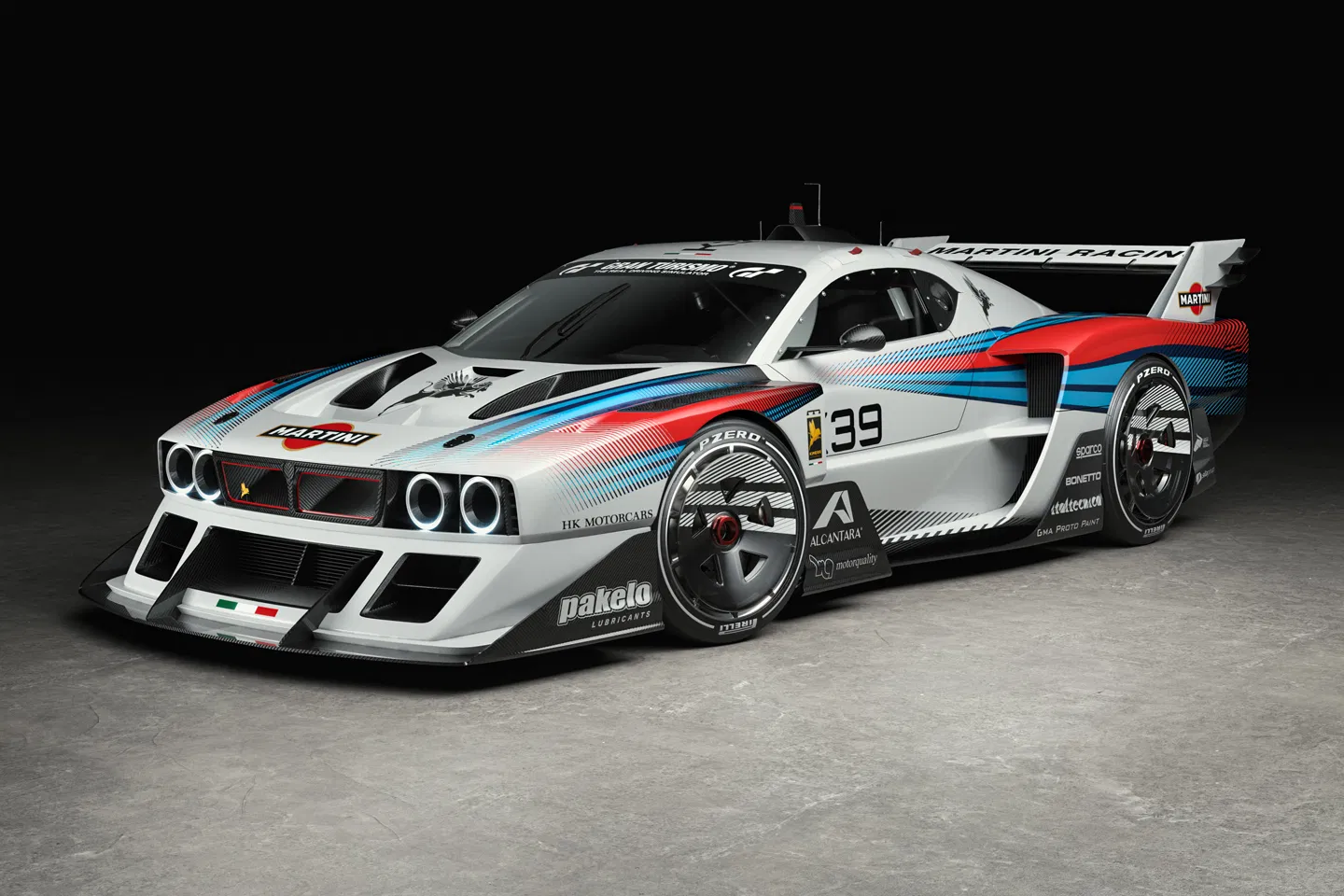
Kimera K39: The Italian Hypercar That Combines Classic Motorsport Heritage with Modern Engineering


Italian boutique manufacturer Kimera Automobili has made headlines with its spectacular restomods like the EVO37 and EVO38. Now, the company has entered an entirely new league with the Kimera K39, its first ground-up hypercar.
Unlike its previous models, the K39 isn’t based on a classic donor car. Instead, it is a completely bespoke machine that combines Italian craftsmanship, race-inspired aerodynamics, and one of the world’s most celebrated powertrains—a twin-turbocharged V8 supplied by Koenigsegg. The result is a lightweight hypercar that pays tribute to legendary endurance racers while delivering modern-day performance. (Kimera Automobili)
Inspired by Racing Legends
The K39 draws heavy inspiration from the Lancia Beta Turbo Group 5 “Silhouette” race cars that competed in the World Sportscar Championship during the late 1970s and early 1980s.
Rather than creating a retro replica, Kimera has reinterpreted those iconic proportions using contemporary design language. The wedge-shaped profile, dramatic rear haunches, integrated aerodynamic channels, and aggressive stance instantly evoke classic Italian motorsport while remaining unmistakably modern. (Kimera Automobili)
Carbon Fiber Construction
At the heart of the K39 lies an all-new carbon-fiber monocoque chassis, marking a major departure from Kimera’s previous projects.
The lightweight architecture provides:
- Exceptional chassis rigidity
- Reduced overall weight
- Improved crash safety
- Better handling characteristics
- Ideal weight distribution
Advanced aerodynamic development has also been carried out with engineering expertise from Dallara, resulting in functional airflow management rather than purely cosmetic styling. Large front ducts, roof-mounted airflow channels, rear diffusers, and an enormous rear wing all contribute to significant downforce.
A Koenigsegg Heart
The biggest surprise is hidden behind the driver.
The Kimera K39 becomes the first production car outside Koenigsegg to receive one of the Swedish company’s legendary engines.
Power comes from a:
- 5.0-liter twin-turbocharged V8
- Approximately 986-1,000 horsepower
- Around 885 lb-ft (1,200 Nm) of torque
- Custom software calibration
- Revised intake system
- Faster-spooling turbochargers derived from the Koenigsegg Agera
While detuned compared to the Jesko, the engine still delivers astonishing performance while improving drivability and reliability.
A Manual Gearbox in a Hypercar
Perhaps the most exciting aspect of the K39 is something almost extinct in today’s hypercar market.
Instead of a dual-clutch automatic, Kimera has paired the V8 with a 7-speed manual transmission, sending power exclusively to the rear wheels.
For driving enthusiasts, this is arguably the car’s biggest selling point. The manual gearbox provides complete driver engagement while maintaining the analog experience that modern hypercars often sacrifice in pursuit of outright speed. Kimera has also indicated that a sequential gearbox may be considered in the future.
Suspension and Driving Dynamics
The K39 uses:
- Double wishbone suspension
- Pushrod suspension front and rear
- Adjustable dampers
- Rear-wheel drive layout
- Motorsport-derived chassis tuning
With a target weight of approximately 1,100 kg (2,425 lbs), the power-to-weight ratio is extraordinary, placing the K39 among the world’s most extreme performance machines.
Designed for Pikes Peak


Kimera isn’t stopping at road-going performance.
The company has announced an even more aggressive K39 Pikes Peak version, developed specifically for the legendary Pikes Peak International Hill Climb.
The race-focused variant features:
- Massive front splitter
- Extreme rear wing
- Larger aerodynamic elements
- Increased cooling capacity
- Track-focused suspension setup
Kimera aims to compete against the world’s fastest hill-climb machines, showcasing the engineering capabilities of this boutique Italian manufacturer. (Kimera Automobili)
Exclusivity
The K39 will be among the rarest hypercars ever built.
Production is expected to remain below 100 units, while only 10 examples of the dedicated Pikes Peak version are planned.
Although official pricing has not been announced, industry estimates suggest the K39 will cost several million dollars, placing it firmly in the ultra-exclusive hypercar segment.
Estimated Specifications
| Specification | Kimera K39 |
|---|---|
| Engine | 5.0L Twin-Turbo V8 |
| Supplier | Koenigsegg |
| Power | Approx. 986–1,000 HP |
| Torque | Approx. 1,200 Nm |
| Transmission | 7-Speed Manual |
| Drivetrain | Rear-Wheel Drive |
| Chassis | Carbon-Fiber Monocoque |
| Suspension | Double Wishbone Pushrod |
| Weight | Approx. 1,100 kg |
| Production | Fewer than 100 Units |
| Special Version | Pikes Peak Edition |
Final Verdict
The Kimera K39 is more than just another limited-production hypercar. It represents a bold fusion of Italian automotive artistry, motorsport heritage, and world-class engineering. By combining a lightweight carbon-fiber chassis with a Koenigsegg-built V8 and an increasingly rare manual transmission, Kimera has created a machine that stands apart from the digital, automatic-heavy hypercars dominating today’s market.
For collectors, enthusiasts, and anyone passionate about analog driving experiences, the K39 is poised to become one of the defining hypercars of its generation—a rare blend of nostalgia and innovation built without compromise. (Kimera Automobili)